

Retrofitting the Enfilade through Guattari's Fourfold Logic of Determinability
A proposed answer to Brassier's critique of ATP using Schizoanalytic Cartographies

Introduction
Ray Brassier’s essay “Concrete Rules and Abstract Machines: Form and Function in A Thousand Plateaus” remains, in my opinion, one of the most sophisticated architectural explanations of the project of stratification in A Thosaund Plateaus. As it eventually goes to show how the project of A Thousand Plateaus effectively crumbles under close scrutiny. As we shall argue forward, it is possible to provide a schizoanalytic patch to the issues Brassier put forward in the essay. Our main argument is thus: Felix Guattari’s Schizoanalytic Cartographies effectively retrofits A Thousand Plateaus with a functionalist architecture. Indeed, in a way we are actually asserting that Brassier’s claims are ultimately correct. But in concerns like these, it has absolutely no importance whomever’s correct or not, only to which degree any perspective put forward can functionally provide a robust-enough architecture to withstand deep scrutiny and close examination.
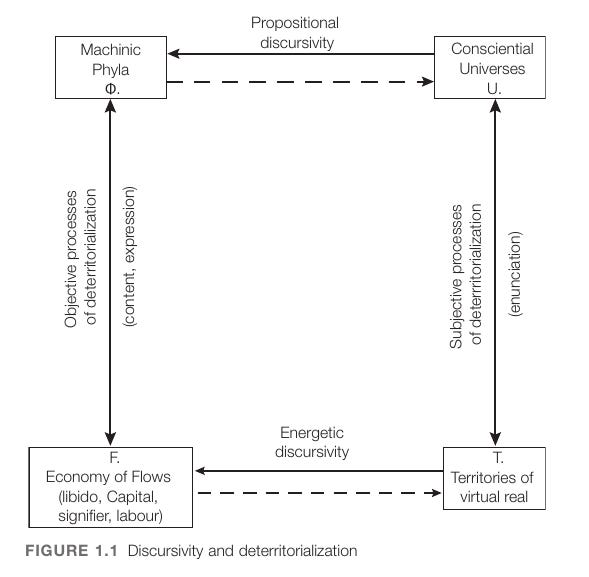
Ray Brassier’s critique of A Thousand Plateaus (ATP) identifies a structural flaw at the heart of Deleuze & Guattari’s machinic pragmatics: fatal reversibility. This occurs because the relation between the concrete assemblage and the abstract machine is modeled as a Janus-faced unity, where stratification and destratification are two aspects of a single, self-referential process. As Brassier demonstrates using Deleuze and Guattari’s own image of the enfilade of doors, this creates a closed series of rooms with no outside corridor. Without this exterior dimension, the criteria for selection—what increases connectivity—can only be determined from within the assemblage itself. This leads to a vicious circularity where the real’s auto-selection through us is indistinguishable from our selection of the real, collapsing into the vitalist indiscernibility between voluntarism and determinism. Guattari’s Schizoanalytic Cartographies can be read as a direct, systemic response to this critique. By disarticulating the Plane of Consistency into four ontological functors—Flows (F), Phyla (Φ), Territories (T), and Universes (U)—Guattari introduces a Cycle of Assemblages that breaks the circularity of auto-construction through rigorous topographical constraints
4, Not 2
“Axiomatics with two terms (of the Being/Nothingness type) necessarily result in an ‘depotentialized’ representation and an inaccessible ‘grund’, whilst dialectics with three terms lead to pyramidal, arborescent determinationS… It is only with 3 + n entities that one can establish: 1) a trans-entitarian (matricial) generativity, without any essential priority of one essence over another (without the infrastructure – superstructure relation, for example); 2) a principle of self-affirmation, auto-retroaction,a self-transcending (Jean-Pierre Dupuy) or auto-poietic (Francisco Varela) foundation.”
-Schizoanalytic Cartographies, page 69
Brassier’s critique of ATP targets the fatal reversibility between the stratified (concrete assemblage) and the destratified (abstract machine), arguing that if the absolute is merely a quality of relative movement, the distinction between them becomes an artifice of representation. Because the abstract machine envelops the strata while simultaneously developing on the plane of consistency, any attempt to destratify immediately risks re-stratifying. The machine flips from destratifying to stratifying depending on the quality of force, leaving no stable mechanism for selection.
We argue that Schizoanalytic Cartographies resolves this by ontologizing the separation between these functions into distinct functors. Unlike the ATP-era rhizome, where lines of flight often collapse into an undifferentiated ground, the Cartographies establishes that the functors operate in different ontological registers: F as Actual Real, Φ as Actual Possible, T as Virtual Real, and U as Virtual Possible. Guattari introduces a principle of exclusion that forbids direct tensorial relations between F and U, and between T and Φ.
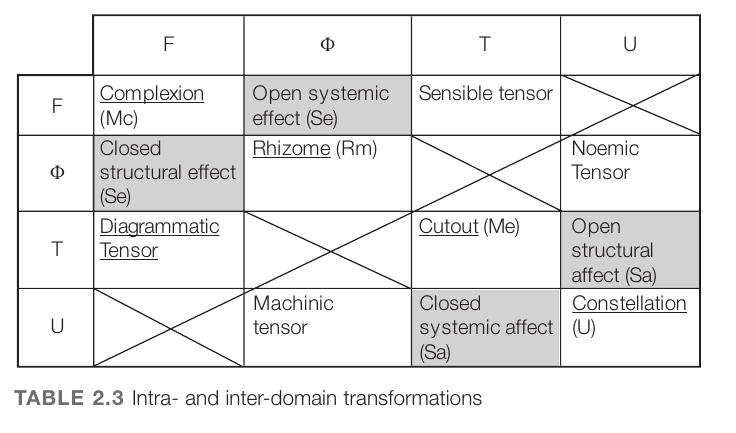
This constraint forces the assemblage to pass through specific synaptic mediators, preventing the autistic closure where form simply falls back onto primary matter.
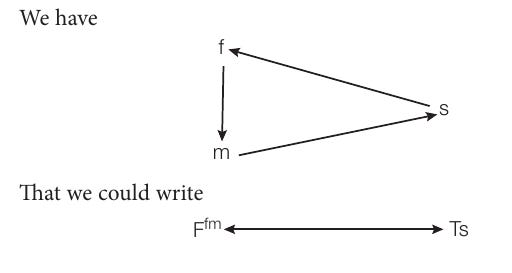
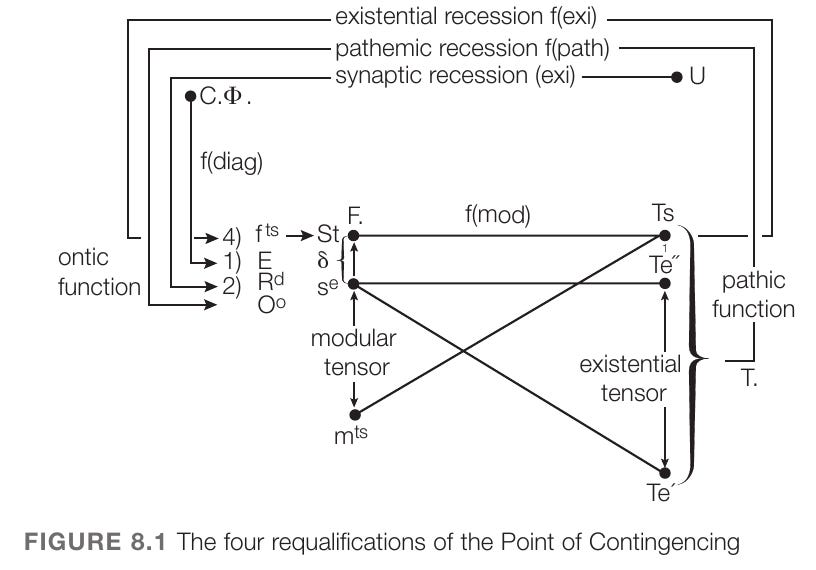
Thus, T (Territories) now exclusively handles the stratified, formed matter and subjective attachment (the “anthropomorphic strata” Brassier identifies as the danger zone). Φ (Phyla / Abstract Machine) is stripped of its Janus face. In SC, Φ is strictly the domain of the diagrammatic function and extrinsic determinability. It is the operator of structural capture, not the source of stratification. By immediately foreclosuring1 T and Φ into distinct domains connected by specific transformational rules (smoothing and striation), Guattari prevents the immediate flip. In ATP, the abstract machine is simultaneously the jailer and the liberator. In SC, the liberator (Φ) operates on a different logical level than the jailer (T). The circularity of auto-construction is broken because the relationship is that of a directional, asymmetrical mapping. Furthermore, we can add that in SC, the Point of Contingencing (Pc) undergoes four distinct requalifications (diagrammatic, synaptic, pathic, and existential). This means that when a process returns to its origin, it is not identical but requalified, effectively breaking the circle of always already and introducing a dated historical irreversibility.
The Outside Corridor: Incorporal Universes (U)
Brassier argues that ATP lacks an outside corridor; a supplementary dimension of overcoding to relate intrinsic dimensions to to arbitrate between a line of flight and a cancerous body. SC provides exactly this, an immanent exterior: the functor U (Incorporeal Universes).
In SC, the U domain provides necessitation, where energy is defined as a "possible become necessary" (SC, 159)2. This is an ontological stamp that confers necessity upon the Phyla of the possible. These Universes act as singularizing constellations that organize the cycle through endo-reference. They escape the energetico-spatio-temporal (EST) coordinates, the iron collar of representation. The synaptic function (f(syn)) in the U domain acts as an elbow that steers the Giving of the system away from mere repetition and toward a unique event. This provides the external anchor by allowing the virtual to guide the actualization of mutant realities without being reducible to them.
Alors, in the functorial cycle, U acts as the ultimate horizon of deterritorialization. It is the domain of virtual enunciation. When an assemblage moves from T to Φ to U, it moves into a different topological dimension. Not just simply entering into another room in the enfilade. U serves as the outside corridor because it provides a non-local standard of consistency that is independent of the immediate territorialized interests of the assemblage (T). While T is defined by endo-reference (self-identity, closure), U is defined by exo-consistency (opening onto the virtual). It prevents the system from collapsing into self-affirmation by forcing the cycle to account for incorporeal fields of reference—such as mathematical invariants, musical phrases, or a-signifying diagrams—that exist beyond the immediate biological or social utility of the assemblage. In Sellarsio-Brandonean terms, we can say that U maps the deprivatized public semantic space of reasons onto the assemblage. Therefore, the measure of consistency Brassier claims is missing in ATP is found in SC as the degree of exo-consistency an assemblage achieves when mapped onto U.
Selection Selecting Connection Against Recursive Causality
Brassier argues that in ATP, selection is connection selecting connection—a tautological auto-construction. SC replaces this with recursive causality, detailed in Chapter 8 of SC. The cycle operates through four distinct causal modalities:
F -> Φ: Necessitation (extraction of diagrammatic constraints from noise).
Φ -> T: Singularization (territorial capture).
T -> U: Irreversibilization (existential refrains opening to the virtual).
U -> F: Heterogenesis.
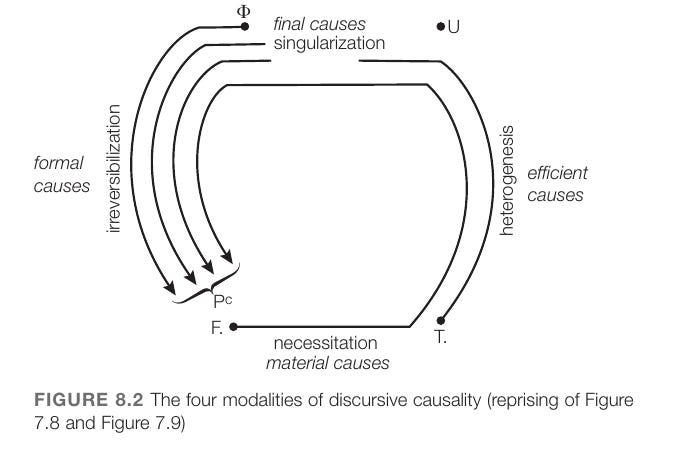
It is heterogenesis that definitively breaks the fatal reversibility. In ATP, the return to the plane of consistency is a constructive diagramming that extracts variables from the strata to create a continuum of intensity. In SC, the return from U to F is a production of the new. U feeds back into F, but it alters the soup of redundancies such that the next cycle begins from a qualitatively different state space. Because the cycle is irreversible and heterogenetic, the absolute (U) is not relativized by the relative (T); rather, the relative is structurally transformed by its passage through the absolute. This introduces a temporal asymmetry that prevents the system from being a closed loop of self-affirmation.
Perhaps Brassier’s most potent charge is that ATP relies on a quality of power (Nietzschean affirmation) that makes the distinction between subjective voluntarism and ontological determinism indiscernible. Affirmation becomes the invisible criterion that already decides the selection. Brassier seizes on this to expose a fatal flaw in the mechanics of selection. According to Brassier, the central question of ATP is: How do we select which connections increase consistency, and which are “cancerous” or “empty”? Deleuze & Guattari answer that selection occurs based on an assemblage's ability or aptitude to map the plane. This ability is cashed out through Spinoza and Nietzsche as the puissance and the quality of force (active/reactive; affirmative/negative). Brassier points out that for Deleuze, the quality of power (affirmation) is not a transcendental principle hovering above the assemblage; it is already actualized within the intensive differences of the assemblage itself. Brassier writes that: "Difference in power is already a difference in being." The indiscernibility is thus:
Voluntarism: If the selection relies on the quality of power, and this quality is manifest in the assemblage, then the subject (the “we” doing the diagramming) must simply recognize and affirm this quality. Selection becomes a subjective fiat; an act of will (personal self-affirmation).
Determinism: Conversely, because the quality of power is already an actual difference in being, the outcome of the selection was already determined by the ontological makeup of the forces. The subject is just a passive conduit for ontological contingency (impersonal self-affirmation).
Therefore, because the abstract machine and the concrete assemblage are Janus-faced (the same process viewed from different sides), one cannot distinguish between the subject choosing the real and the real choosing the subject. The criterion for selection (affirmation) is swallowed by the thing being selected.
SC escapes this vitalist trap through its rigorous development of a-signifying semiotics and the E.C. bipolarization (Enunciation/Content).
E.C. bipolarization
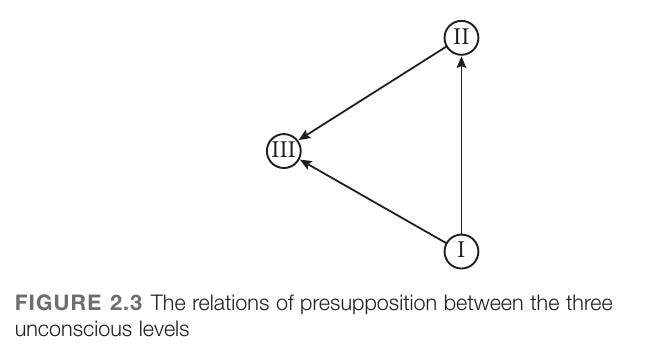
Brassier’s first horn of the dilemma is subjective voluntarism, the idea that “we” choose the real through an act of will. In ATP, the concrete rules are questions that “we” ask. The E.C. bipolarization occurs at Level II (The Semiotic Unconscious), which is defined by Separation and Semiotic Tensors.3 Very importantly, Level III (The Pragmatic and Subjective) presupposes Level II. This means the E.C. bipolarization is not an act of the conscious or pragmatic subject (Level III). The subject cannot choose to bipolarize a flow any more than a digestive system chooses to secrete enzymes. The E.C. cut is an synthetic, structural operation of the Semiotic Unconscious that conditions the pragmatic subject. The projectile vectors of the Semiotic Tensors execute the cut before the subject emerges to affirm it. Voluntarism is structurally bypassed because the subject is the product of the E.C. bipolarization, not its author.
Brassier’s second horn is ontological determinism, if it’s not subjective will, it must be mechanical tracing of physical forces. Guattari characterizes semiotic tensors as that which “engender sites of sense entities… in domains lateral to those of their point of origin.” (SC, 55). The E.C. bipolarization begins in the domain of F, specifically within the Matter of Content (Mc) and the Diagrammatic function (Diag) within F. This is the domain of the Actual/Real, energetic-spatio-temporal discursivity, and endo-consistency (the "looping arrow" of F's internal calibration). If the system were deterministic, the tensor would just trace the energetic flow. But the E.C. bipolarization forces a lateral jump. The Enunciation pole of the tensor acts as a projectile vector4 that jumps across the horizontal axis of Discursivity. Level II tensors bear a surplus value of possibility. This surplus is carried laterally into the domain of Machinic Phyla (Φ), specifically crystallizing as Machinic Propositions (Pm), which are defined as bearers of symmetric-fractal and deterritorialized representation of ruptures of contingency.5 The Enunciation pole of the E.C. bipolarization does not mechanically represent the flow; it extracts a rupture of contingency from it and projects it into the domain of the Possible (Φ). Because this vector points toward the Virtual/Possible (exo-consistent), it cannot be reduced to the causal mechanics of the Actual/Real (endo-consistent). Determinism is defeated by the structural introduction of possibility.
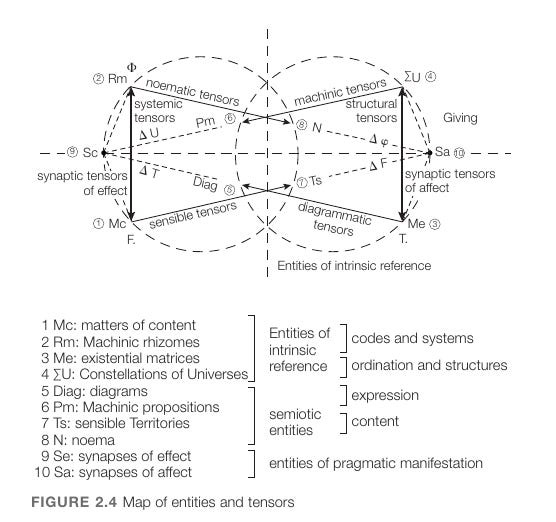
Alright then, how do we measure if an E.C. bipolarization is successful (how do we avoid the “cancerous body”)? We evaluate its tensorial trajectory:
Did the tensor successfully achieve Separation (Level II) from the non-separability of the Flows (Level I)?
Did it carry its surplus value of possibility laterally into a Machinic Proposition (Φ) rather than collapsing back into the looping arrow of the Matter of Content?
Can this Machinic Proposition eventually be “incarnated” into a Sensible Territory (Ts) without being recaptured by a homeostatic reterritorialization?
A-signifying semiotics and sign-particles
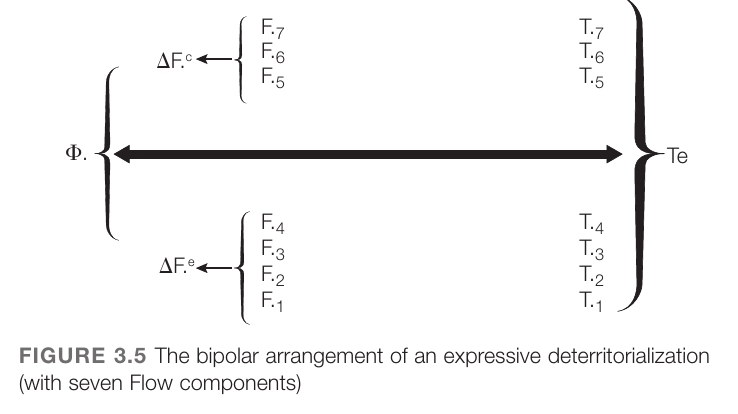
In ATP, even deterritorialized signs (tensor signs) retain a trace of expressive subjectivity, they Spinozistically express a continuum of variation. In SC, the diagrammatic function of Φ produces sign-particles (sp) that are strictly a-signifying. A-signifying semiotics operates by reference, not signification. The sign-particle indexes a state of matter or a position in a phase space. It is a proto-energetic operator.
This defeats voluntarism because the subject does not choose the meaning of the sign-particle; the subject is constructed by the diagrammatic trajectory of these particles.
This defeats determinism because the sign-particles are not mechanical representations of a pre-given reality; they are operators of smoothing that extract new potentials from the noise (F).
By shifting from signifying expression (which relies on the quality of the speaker’s intent or force) to a-signifying reference (which relies on the structural function of the particle in the diagram), Guattari replaces the vitalist criterion of affirmation with the functionalist criterion of constraint. The objective ground is no longer the will to power or the plane of consistency, but the structural constraint of the diagram (Φ) as it maps the incorporeal (U) onto the material (F).
But we need to be very careful. If we remove subjective meaning, we are left with mechanical indexing. But this falls directly into the Determinism horn of Brassier’s dilemma. If the sign-particle merely indexes the state of matter, then the diagram is just a passive tracing of physical forces. The subject disappears entirely, and selection is reduced to causal determinism. To escape the enfilade, a logical and epistemological architecture that provides an exterior standard for selection that is neither subjective will nor mechanical tracing is needed. A-signifying semiotics may describe the material of the diagram, but it lacks the logic required to measure consistency.
Segovia’s Intervention: Determinability, Situated Transcendental, and Heidegger
We argue this is precisely where Carlos A. Segovia’s Guattari Beyond Deleuze: Ontology and Modal Philosophy in Guattari’s Major Writings provides a crucial intervention. Segovia, following Althusser,6 argues that SC represents an epistemological break in Guattari’s thought, moving from a metaphysics of deterritorialization (escaping the given) to a modal philosophy of determinability (constructing the possible).
Segovia writes that in SC, the term "determinability" appears over ninety times. In ATP, the movement is from strata to destratification (via affirmation). In SC, the movement is from the Indeterminate (+∞ chaos) to the Determinable (Φ, the diagrammatic) to the Determined (−∞ consistency). Determinability is a logical modality, as it describes the capacity of a system to be structured without the structure being already present, breaking the actualization trap. The criterion for selection is now: “does this increase the logical determinability of the system?”
Brassier demands an outside corridor to prevent the enfilade. Segovia demonstrates that SC provides this through the isonomic status of the four functors. Guattari explicitly rejects a two-term (binary) or three-term (dialectical) model because they lead to depotentialized representation or arborescent determination. The four-functor model (F+Φ+U+T) creates a “trans-entitarian matricial generativity.” (SC, 69).
T is the determined (the room).
U is the determinable (the incorporeal horizon).
F is the indeterminate (noise).
Φ is the operator of determination.
The outside corridor is the structural matrix itself. Because no functor can have essential priority over another, the system is open. The relationship is thus a chiastic interplay where A defines B by differing from it, and B defines A by differing from it. This structural reciprocity provides the exterior viewpoint: one evaluates an assemblage not from within its own self-affirmation, but from its structural position relative to the other three functors.
Segovia emphasizes a crucial 1990 dialogue where Guattari explicitly rejects the ATP-era logic of "getting out."
“The outside is not a neutral field... It’s an exterior in the form of a particular constellation of universes of reference.” (GBD, xiv).7
The outside corridor is U, but crucially, these aren’t chaotic voids, but as complex, incorporeal universes that possess a specific consistency. U acts as the non-subjective, non-mechanical standard of measurement. It is the situated transcendental. It is transcendental because it provides the a priori horizon for selection (it is not reducible to the immediate territory T). It is situated because it is not a Platonic form, but a constructivist constellation generated by the cycle itself.
The selection of an assemblage is thus a functional evaluation of structural integration: does this diagram (Φ) successfully map the flows (F) into a habitable territory (T) that is consistent with a constellation of incorporeal universes (U)?
Furthermore, in his 2022 essay ‘Guattari⧹Heidegger: On Quaternities, Deterritorialisation, and Worlding.’ Segovia maps Guattari’s F, Φ, U, T onto Heidegger’s Geviert (Earth, Sky, Mortals, Immortals), which operates through a mirror-play (Spiel) of reciprocal differences. In SC, worlding replaces deterritorialization. One doesn’t escape the territory (T). but constitutes a world by structurally reciprocating the Flows (F), the Phyla (Φ), and the Universes (U). The system is open not because it has no boundaries, but because its boundaries are topologically folded (like a Möbius strip or Klein bottle, as Segovia notes).
Brassier’s trap, which is that of selection collapses into either subjective voluntarism or ontological determinism, relies on the univocity of Being in ATP. Because there is only one kind of substance (intensity), the only way to differentiate is by the quality of force (affirmation), leading to the fatal indiscernibility. Segovia uses Heidegger, and by extension Aristotle’s four causes,8 to prove that SC abandons univocity for chiastic dyadic structuralism. Segovia writes that in Heidegger’s Geviert, the elements do not have essential priority over one another. The Earth (the opaque, resisting ground) only becomes manifest through the World (Sky, Mortals, Immortals), and vice versa. It is a structure of reciprocal determination (A is the inverse of B; F=Φ^-1). If the structure is strictly chiastic, the indiscernibility vanishes. The subject cannot arbitrarily affirm a connection, because a connection only counts as valid if it structurally co-implicates the other three functors. Thus worlding becomes a schizoanalytic imperative, solving voluntarism. The outcome is not mechanically determined by physical forces, because the Possible (Φ and U) has primacy over the Real (F and T). The structural horizon (U) actively shapes the material flows, meaning the determination runs bidirectionally across the diagonals, solving determinism.
Brassier complained that ATP lacked a standard to measure consistency because the plane selected itself through us. Segovia uses Heidegger’s modal framework to show how SC recovers an objective standard. Segovia maps Heidegger’s modal axes onto Guattari’s quadrant:
F and Φ = The Referred / The Given / The Actual / Content (Earth/Mortals)
U and T = The Referring / The Giving / The Virtual / Expression (Sky/Immortals)
In ATP, because the abstract machine was Janus-faced, the given and the giving collapsed into each other (auto-construction). But by aligning SC with Heidegger’s Geviert, Segovia shows that Guattari reinstates a structural asymmetry. U acts as the final cause. The Incorporeal Universes are the giving; they provide the a priori horizon of consistency against which the given (F) are measured. Therefore, selection is no longer connection selecting connection. Selection (T) is the alignment of the Given (F) with the Giving (U) under the constraint of the Formal Cause (Φ).
Conclusion
Brassier is ultimately correct. ATP falls under its own architecture. Brassier’s critique of A Thousand Plateaus stands as a masterful and ultimately unassailable diagnosis of the vitalist limitations inherent in Deleuze & Guattari’s earlier machinic pragmatics.9 Brassier correctly identifies that the ontological architecture of ATP, which can be defined as a univocal plane of consistency where the abstract machine and the concrete assemblage are Janus-faced, necessitates a fatal reversibility. Because selection relies on the actualized quality of power (affirmation) immanent to the assemblage itself, the criterion for measuring consistency is swallowed by the thing being measured. The result is the spatial image of the enfilade of doors: a closed, self-referential series devoid of an exterior vantage point. In this closed loop, the distinction between the real auto-selecting through us (ontological determinism) and us selecting the real (subjective voluntarism) becomes strictly indiscernible.
However, Brassier’s critique, while devastating against ATP, does not mark the terminus of schizoanalysis. Rather, it accurately maps the exact problem that Guattari’s Schizoanalytic Cartographies was engineered to solve. SC answers back to Brassier’s demands not by abandoning immanence, but by mutating Schizoanalysis from a univocal metaphysics of vitalist escape into a rigorous, neo-structuralist functionalism of modal constraint. SC resolves Brassier’s critique through three precise operations.
It breaks the enfilade by shattering the Janus-faced unity of the abstract machine. By ontologizing the distinction between Territories (T), Phyla (Φ), Flows (F), and Universes (U), Guattari replaces the rhizomatic line with a chiastic matrix. As Carlos A. Segovia demonstrates, this four-functor model operates on a structural logic of reciprocal determination (F=Φ^−1). This matrix geometry, which mirrors the topological mirror-play of Heidegger’s Geviert, generates the outside corridor Brassier demanded. The exterior is the structural horizon provided by the Incorporeal Universes (U), which function as a situated transcendental. U provides the exo-referential standard of consistency necessary to measure an assemblage without collapsing back into subjective self-affirmation.
SC escapes the indiscernibility between voluntarism and determinism by replacing the vitalist criterion of affirmation with the modal category of determinability. In ATP, the quality of force is already actualized, leading to a deterministic trap. In SC, the relationship between the Indeterminate (chaos), the Determinable (the diagram), and the Determined (consistency) is strictly asymmetrical. Selection is a functional evaluation of how effectively the diagram (Φ) maps the constraints of the incorporeal (U) onto the material flows (F) to delimit a habitable territory (T).
The problematic reliance on a-signifying semiotics is salvaged when stripped of its vitalist residue. Isolated, a-signifying semiotics threatens to reduce thought to passive, mechanical indexing (pure determinism). But situated within the four-functor cycle, a-signifying indices become the exact material through which structural constraint (Φ) operates. They defeat subjective voluntarism (the sign does not mean what I want it to mean) without succumbing to mechanical tracing (the sign indexes a position within a dynamic, recursive topology).
Thus, Brassier is correct: a philosophy based on the univocity of intensity and the vitalist primacy of deterritorialization cannot ground an objective standard of selection. But SC reveals that schizoanalysis was never permanently bound to that ontology. By transitioning to a chiastic structuralism of Guattari’s later constructivism, Schizoanalysis provides a functionalist architecture. It answers the critique by proving that measure can be generated immanently through the rigorous, recursive constraint of a fourfold structural matrix.
Measurement of an Existential Territory & Specifications
The question is now thus: How to specifically measure the consistency of an Existential Territory? For the sake of brevity, we shall only possess 3 metrics of measurement forward:
The Pseudo-Identity Test (The U → T Vector): The first metric is found in the vector from Universes (U) to Territories (T). A Territory is consistent only if it successfully incarnates a Constellation of Universes (ΣU) via pathic operators of heterogenesis. How to measure it? One evaluates the contours of the Territory. If the Territory has fixed contours, if the sense of identitarian isomorphism is rigid, dogmatic, heavily signifying, or heavily reterritorialized onto a master signifier, as in Oedipus, nationalist, or corporate identity, it fails the test. The Territory must exhibit a pseudo-identity without fixed contours. It must maintain enough structural integrity to be a “lived-in space” (endo-consistency), but its borders must be permeable, shifting, and defined by the virtual Universe it incarnates rather than by external social imposition; plasticity without dissolution.
The A-Signifying Synapse Test (Level III Actualization): Territories operate at Level III (The Pragmatic and Subjective), which presupposes Level II (The Semiotic). Therefore, a Territory’s consistency is measured by how it handles the E.C. bipolarized signs passed down to it. How to measure it? One evaluates the Pragmatic Synapses (Se) of the Territory. If is attempted to translate the a-signifying sign-particles (sp) and machinic propositions (Pm) from Level II into conscious meaning, narrative coherence, or signifying interpretation, the Territory is inconsistent, short-circuiting the diagrammaticity10 of the sp and Pm into a scientist mythology or a neurotic narrative. The Territory must actualize Effects without signifying them, operating the diagram pragmatically. Does the subject do the diagram (enact the pragmatic synapse) without needing to represent it consciously? If the Territory functions like an embodiment of digrammatic practices, then we can say that it passes the test; operativity without hermeneutics.11
The Necessitation Test (The T → F Vector): A Territory that perfectly reflects a Universe but floats entirely in the virtual is inconsistent, a delirium, a “cancerous body” disconnected from reality. The arrow from T back to F is necessitation, which can be defined as the existential function that binds territories back to the material and signaletic flows, involving a choice for finitude. How to measure it? One evaluates the Territory’s capacity for finitude. If the Territory refuses the T → F vector, c’est-a-dire, if it tries to remain in absolute deterritorialization, refusing to bind back to the Matter of Content (Mc), it becomes a void, a black hole of absolute escape, falling into catatonia. The Territory must successfully make a choice for finitude. It must accept the necessitation of binding its virtual consistency back into actual, energetic-spatio-temporal flows (F).12 It must agree to constitute a world rather than endlessly deconstructing one. Consistency here is the successful grounding of the virtual in the resistance of matter.
In the SC framework, the measurement of an Existential Territory’s consistency is a structural equation: Consistent T = (U-incarnated as pseudo-identity) + (Level II tensors actualized as a-signifying pragmatism) + (F-bound through necessitation/finitude).
If an assemblage fails the first test, it is a stratified Territory (fascist/paranoid).
If it fails the second, it is a signifying Territory (neurotic/interpretive).
If it fails the third, it is a delirious Territory (schizoid/catatonic).
But we need to be extremely careful. Writing that the Territory “incarnates…”, “…how it handles…”, “…reflects…” only leaves us falling back into subjective voluntarism. How are we to verbalize then? If the Territory doesn’t actively “balance” the functors (avoiding voluntarism), and it isn’t passively “determined” by them (avoiding determinism), what is it?
In a deterministic system, the foundation (Level I / Flows) dictates the outcome (Level III / Territory).13 In SC, the outcome feeds back and alters the foundation. When the Territory (Level III) actualizes the pragmatic effects of the diagram, it adjusts the quantum configurations of the primary unconscious (Level I). This means the rules of the game are changed by the very act of playing it.14 The Territory produced at T1 structurally mutates the Flows that will produce the Territory at T2.
Thus, the Territory adjusts. “Adjusting” is the operative verb proper to T. It implies a system under structural tension, not a system under control (voluntarism) or a system running blindly on tracks (determinism). T is a site of a structural negotiational navigation across scales. The cycle produces T based on past conditions. T actualizes the E.C. bipolarizations (Pragmatic Synapses). These actualizations introduce ruptures of contingency (Pm) that cannot be predicted. T feeds these ruptures back to Level I, adjusting the proccesual cycle.
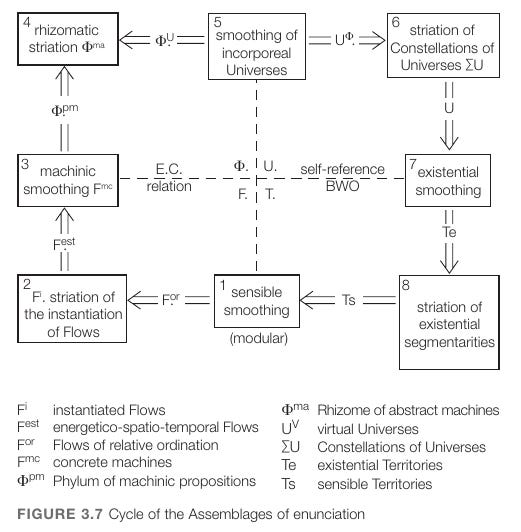
Immediate foreclosure refers to the a priori topological constraint that separates the objective domain of actual possibilities (Φ) from the subjective domain of virtual reality (T). There is no direct path between the Being-there of a territory and the abstract rules of the phylum. The foreclosure of T and Φ means that the subject (T) does not have direct, unmediated access to the truth of the Flows. Instead, the Given must be processed through the abstract machines of the Phyla, which act as mutational filters that linearize the noise of the soup of redundancies (m=0) into manageable, proto-machinic sequences. This surpasses the myth of the given as pre-conceptual data (F) do not and cannot possess inherent epistemic authority without the mediation of the space of reasons (U). While T and Φ are foreclosed from direct interaction, they are connected via a cycle of assemblages governed by tensorial rules of transformation: smoothing and striation. Tensors are multi-dimensional vectors that facilitate indirect transformations across the gaps between functors. Smoothing (Conversion) operates between quadrants to create a new homogeneity, such as sensible smoothing (F-T), which transforms raw flows into the vital minimum of consistency (m=1) required for a territory to take hold. Striation (Enrichment) operates within a domain to enrich its complexity, such as rhizomatic striation (Φ), which organizes possibilities into a Rhizome of abstract machines. The immediate flip is prevented because any movement from Φ to T must pass through the Incorporeal Universes (U), where virtual values and fecund moments (Kairos) singularize the abstract rules before they can be somatized into a new existential territory.
Guattari, F. (2012). Schizoanalytic Cartographies (A. Goffey, Trans.). Bloomsbury Publishing.
E.C. bipolarization occurs at Level II because this is the level characterized by separation and the transition from passive to active registration of heterogeneity. At this level, the unconscious moves beyond the non-separability and intrinsic reference of Level I to establish the components of semiotization required for discursivity and the production of new possibilities.
One might take issue with the mathematical validity of the functives of vectors and tensors used by Guattari, but doing so is beyond the scope of this essay.
If we follow Sacilotto’s revision of representation in Structure and Thought: Toward a Materialist Theory of Representational Cognition as a mapping and localization function, we can conceptualize representation as a localization of ruptures. Sacilotto employs the concept of a locator, a function of variable dimensionality that determine the parameters through which a system extracts relevant information, that is to say, real patterns from background noise. Representation is understood by Sacilotto as a structural equivalence between the pattern-governed regularities of the representing system and the pattern-governed regularities of the world. This deterritorialization of representation is not its destruction or total dismissal, but its unbinding from the here and now, allowing for the construction of rich, counterfactual modal spaces that track the irreversible noise of any specific Territory.
Knox Peden, in Spinoza Contra Phenomenology: French Rationalism from Cavaillès to Deleuze, characterizes Althusser’s project as a rigorous rationalist attempt to separate Science from Ideology (the lived experience), a move we can say that Guattari formalizes and functionalizes by replacing Althusser’s "epistemological break" with a cycle of machinic heterogenesis. Peden explains that Althusser’s epistemology relies on the three generalities to describe the production of knowledge. These can be Guattarianlized (metamodelized) as follows:
Generality I (Ideological concepts/Ossified facts): This corresponds to Guattari's Flows (F). It is the raw material or soup of redundancies (m=0) where sensations and individuals reside before being processed by theory.
Generality II (Scientific Theory/Theoretic-Technical Complex): This is the domain of Machinic Phyla (Φ). Φ provides the abstract machines, algorithms, and diagrammatic connections (Generality II) that work upon the raw Flows (Generality I).
Generality III (Concrete-in-thought/Knowledge): This corresponds to the Incorporeal Universes (U). In Peden’s Althusser, Generality III is the new scientific entity produced by theoretical labor. In Guattari, this is the "niverse of value or fecund moment where a-signifying signs (like mathematical formalisms) gain existential consistency without returning to the lived.
Furthermore, Knox Peden emphasizes Althusser’s anti-humanism, where the subject is merely an effect of a structure, constituted through interpellation (”Hey you!”). Althusser’s Ideological State Apparatuses (ISAs) are the collective apparatuses of subjectification. We can map the Althusserian subject onto Existential Territories (T). While Althusser sees the subject as a simple support or empirical bearer of ideal structures, Guattari defines the subject as a shifter within a collective assemblage. The imaginary relationship Althusser attributes to ideology is redefined by Guattari as sensible smoothing, where the subject (T) achieves a habitable consistency by filtering the chaotic Flows (F) of the real.
Segovia, C. A. (2024). Guattari Beyond Deleuze: Ontology and Modal Philosophy in Guattari’s Major Writings. Springer Nature Switzerland.
Which Guattari already uses in Chapter 8.
Not really. One can pinch at Brassier through Difference Repetition’s reversion of Platonism. There, Deleuze redefines the Idea as a problem, following Lautman and Maimon. Following Albert Lautman, Deleuze argues that the problem has an objective consistency and genetic power that is irreducible to its particular solutions. The Idea is a system of ideal connections or differential relations (differentiation) that precedes and determines the field of actual solutions (differenciation). Drawing on Salomon Maimon, Deleuze insists that the conditions of possible experience (Kant) must be replaced by the conditions of real experience. This requires a genetic account where the understanding does not just think general relations between objects but actually determines objects by relations through the reciprocal determination of differentials. The Idea is thus defined by Deleuze as a distribution of singular and regular points. These singularities are the shining points that determine the conditions of a problem and its field of solvability. Deleuze replaces the noble Platonic question “What is this?” (essence) with minor questions, such as “Who?” “How?” “Where?” “When?”, which determine the transcendental coordinates of a purely immanent Idea rather than a stable model. Brassier misses chapter 4 and 5 of Difference and Repetition, in favour of going at Nietzsche and Philosophy and Expressionism in Philosophy: Spinoza.
But it is more nuanced than that. In the earlier essay The Expression of Meaning in Deleuze’s Ontological Proposition, Brassier does analyzes the intertwining structure of DR, specifically citing the material from Chapter 4 on singular points and the Idea as virtual multiplicity. He also discusses Chapter 5’s themes, such as the centres of envelopment. At the end of the day, while Brassier does discuss these chapters, his interpretation aligns with the representational nihilism or idealist monism he attributes to Deleuze. Brassier argues that Deleuze’s account of the Idea and its larval subjects (from Chapter 5) relies on a biocentric or panpsychist premise. He claims Deleuze includes muscles and water within the ambit of actual experience but cannot account for galaxies and electrons, because his passive synthesis is tethered to the organic. (But to problematize this interpretation would necessitate going into Raymond Ruyer’s and Simondon’s project, as there are Deleuze’s main sources for those claims). Furthermore, Brassier questions whether Deleuze is mathematizing meaning or simply semanticizing mathesis in a way that re-subordinates the Idea to anthropological predicates. He argues that by beginning from a top-down approach where designation presupposes sense, Deleuze remains trapped in a “myth of an originally intelligible and hence enchanted world”.
Thus, while the mathematical and problem-centered rigor of Difference and Repetition is often overshadowed by the more vitalist vocabulary of Deleuze’s later work with Guattari, Brassier interprets the immanent Idea as an idealist residue (Perhaps this being residue itself of his even earlier critique in Alien Theory), a conceptual black box that refuses to separate ontological genesis from epistemological synthesis. Indeed, Brassier’s interpretation can be further taken apart and analysed, but this goes beyond the scope of our essay.
A diagrammatic short-circuit might be the worst that could ever happen to thought. Diagrammaticity is fundamentally defined by the gesture, which is primary and irreducibly not algorithmic. A gesture awakens other gestures, creating formal novelty that no rule could predict. A short-circuit reduces the gesture (which perturbs equilibria) to a mere act (a protocol-governed, endlessly repeatable segment). Thought ceases to be vectorized as a germ that must blossom uncontained onto infinity and becomes a reproductive meter. Instead of jumping over figures to construct new worlds, thought remains entangled in figurative givens. In Guattari’s semiotics, the productive diagrammatic cycle (Procession and Recession) is what imprints necessity and singularization onto the real. A short-circuit results in the autistic closure, where proto-machinic figures prohibit communication with the outside. Form continually falls back onto primary matter in a state of formal reiteration where nothing new can occur. The refrain, which should be an excited state catalyzing new morphogenetic processes, is short-circuited into an atonic state, becoming dead memory, a witness-remnant that merely marks the being-previously-there of a defunct state. The ultimate danger of a diagrammatic short-circuit is the black hole effect, a point of total semiological powerlessness. The short-circuit triggers a node of resonance that attracts and isolates all redundancies, emptying them of their content. Thought begins to spin around itself, losing any object or support, falling back into the myth of the given, as the diagram doesn’t exercise enough puissance for the mapping function to achieve pictorial adequacy, assuming that forms are already there rather than being constituted through the inhuman labour of the diagrammatic cycle; a disempowered representation trapped within signifying abstractions. In a word, schizophasia.
One ought to treat the dismissal of hermeneutics with utmost care and precision. We cannot dismiss epistemology. Perhaps the biggest quarrel neorationalists have with Deleuze & Guattari is that they subsume epistemology under ontology. Without a concrete and robust epistemology, schizoanalysis falls under its own architecture. As Daniel Sacilotto, in Structure and Thought: Toward a Materialist Theory of Representational Cognition, warns, to abjure representational mediation altogether risks a relapse into a heraclitean empiricism where materiality is naively identified with subjective becoming, rendering the relation between the model and the world unintelligible. We must adopt what Negarestani, following William Wimsatt, calls an engineering epistemology, an upgradable set of heuristics attentive to the requirements of different functional hierarchies. A robust epistemology for schizoanalysis must maintain the logical irreducibility of the normative (Level III) while acknowledging its causal reducibility to nature (Level I).
To directly quote from my Guattari notes: “I argue that the cycle of assemblages of enunciation really begins with a striated existential segmentarity, that then leads to sensible smoothing. The “pre-given” existential segmentarity provides an initial state of heterogeneous elements, including possibilities, and established forms. Sensible smoothing then acts upon this state, initiating the process of converting its inherent—but potentially chaotic—redundancies into organized, proto-machinic flows (Through For and Fest). This is the very first step in making the heterogeneous components of existence usable and functional within the broader assemblage. Really, if the reader notices, the cycle operates with a dual rhythm of smoothing and striating movements, where smoothing enables the transition from one functor to the next, while striation condenses the process around each functor. Therefore, sensible smoothing is the initial transition or ontological conversion from the more stable, yet internally varied, segmentarity.”
While Level I (Flows/Given) may exert a causal impact on our senses, this impact does not automatically constitute a reason or a justification for a specific outcome in Level III (Territory/Giving). Sellars argues that knowledge as a rational system of judgments is irreducible to any causal fact; no point of view external to knowledge can be engendered solely through a manifestly transcendent causal relation. There is a fundamental gap between experiential contact (Level I) and justification (Level III). To assume that the foundation dictates the outcome is to swallow the myth that being is disclosed directly to experience without conceptual mediation.
In dynamic epistemic logic (DEL), the meaning of an utterance or action is best interpreted as a cognitive program that changes the information states of the participants, bringing to the forefront of logic dynamic update conditions. Just as actualizing a Territory in Level III restricts and reconfigures the possible states in Level I, a public announcement in DEL restricts the current epistemic model to only those states where the announcement is true, thereby creating a new accessibility relation. DEL allows for reasoning about how an agent’s beliefs are updated in light of new evidence, a Guattarian feedback loop where the present of pragmatics (Level III) does not simply follow the past (Level I) but dates and eventalizes states of fact, forcing the system into a far-from-equilibrium state that demands new models. Ditmarsch, H. v., Hoek, W. v. d., & Kooi, B. (2007). Dynamic Epistemic Logic. Springer.
Something similar is found in Jean-Yves Girard’s ludics. In ludics, as read by Reza Negarestani in Intelligence and Spirit, we find a logico-computational framework that fundamentally mirrors the dynamic feedback loop where the rules of the game are changed by the act of playing it. This system shiftes from static, monological axiomatics to an interactive paradigm where rules and meanings emerge through the processual engagement of agents. Negarestani characterizes ludics as a pre- or proto-logical framework that analyzes logical phenomena at their most elementary level, that is, the locus or the address of a sign’s inscription. Unlike traditional game theory or classical logic, interaction games in ludics are devoid of predetermined winning strategies, payoff functions, or procedural rules. Instead, rules naturally emerge from the interaction itself as the dialogue progresses. Negarestani argues that interaction is the deepest computational phenomenon. In this framework, computation is not a closed deductive function (input-to-output) but an evolving interaction between a system and its environment, mirroring the Guattarian present of pragmatics. Similar to the way a public announcement in DEL restricts possible states and creates a new accessibility relation, moves in a ludic interaction reconfigure the logical landscape. Through a process called focalization, the interaction progressively topicalizes itself. As polar strategies (prover and refuter) exchange loci and subloci, they “reveal logical constants and rules that are not a priori given, but adaptively emerge” (IS, 371). These interactions are governed by computational dualities (the interchange of roles between processes), which result in the generation of additional constraints or rules that increase the complexity of the behaviors involved; the formal equivalent of the Territory (Level III) reaching back to adjust the quantum configurations of the Flows (Level I). The system is inherently non-monotonic because the rules are constituted by the act of engagement, the addition of new evidence or a new move can fundamentally revise or retract prior conclusions. Negarestani, R. (2018). Intelligence and Spirit. Urbanomic.